I was sitting in a creative review meeting with a mid-size skincare brand last month when the marketing director dropped a bombshell. They had quietly run an A/B test on their homepage for two weeks. Version A used a set of gorgeous, hyper-realistic AI-generated lifestyle images showing models using their products. Version B used traditional, expensive photography shot in a rented studio.
The layout, the copy, and the products were identical. But the real photography outperformed the AI images by a staggering 23% in conversion rate.
Here’s the wild part: when asked in a follow-up survey, most customers didn't explicitly realize the first set of images was AI. But they subconsciously felt it. The skin textures were slightly too flawless. The lighting was mathematically perfect. The backgrounds lacked the messy, random reality of a real bathroom counter. It whispered, "this isn't real," which instantly eroded trust in a physical product they were expected to put on their real faces.
Yet, that same company uses AI to generate 90% of their blog headers, mood boards, and social media concept art, saving them thousands of dollars a month without dropping a single metric.
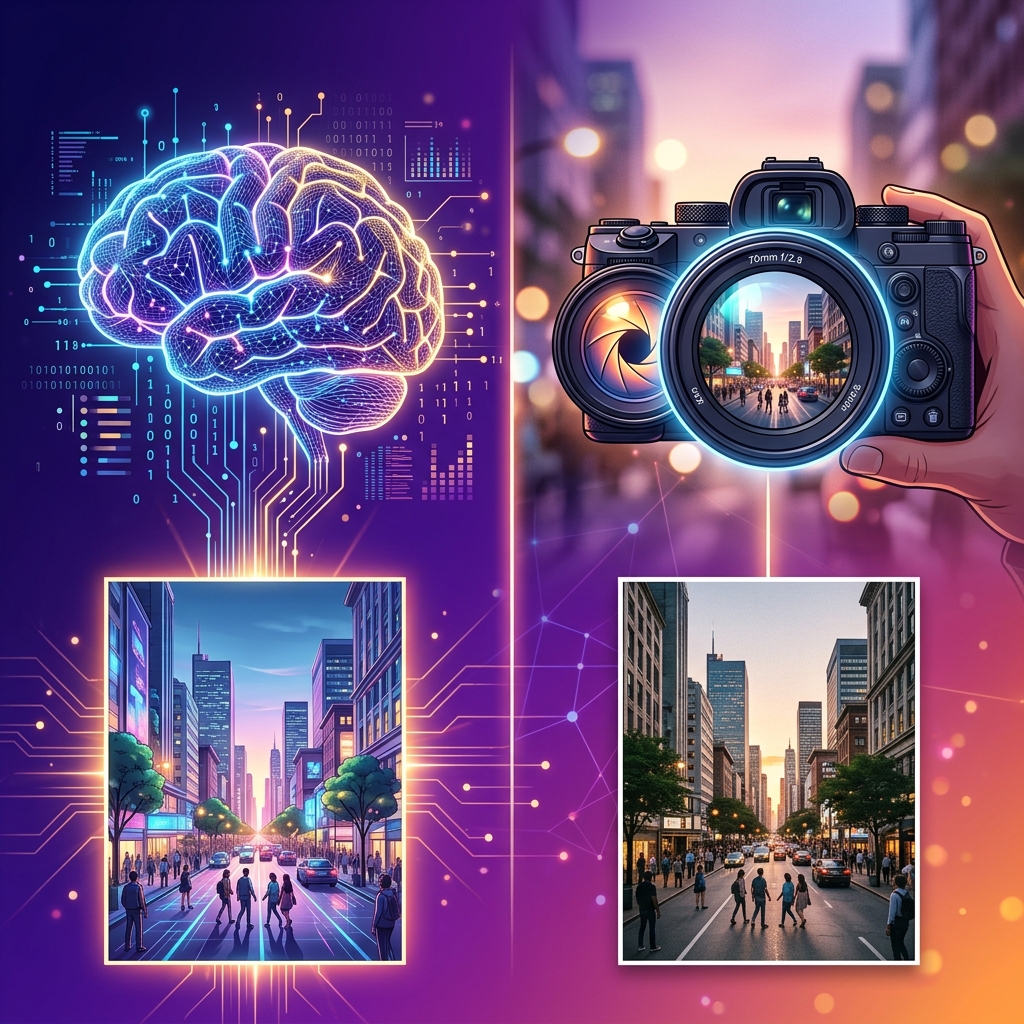
The whole "AI vs. Photography" debate is completely broken because people treat it like a cage match where only one can survive. After building content strategies for dozens of brands, I can tell you that it’s not a binary choice. It’s about context. Here is exactly how to navigate this landscape in 2026, avoiding the expensive mistakes and leveraging the strengths of both.
When AI Generators Completely Dominate
Let's start with where AI absolutely shines. If you are doing any of the following, hiring a photographer is probably a waste of time and money.
1. Abstract Concepts and "Future" Scenarios
Try hiring a photographer to shoot "the abstract concept of cybersecurity in the quantum era." You can't. You'll end up buying a cheesy stock photo of a guy in a hoodie typing green code. AI generators eat abstract concepts for breakfast. You can prompt an AI to visualize "digital transformation" or "remote work synergy" and get a polished, unique, and conceptually fascinating illustration in ten seconds. For blog headers and presentation slides, AI is untouchable.
2. Rapid Prototyping and Mood Boarding
I never commission a photo shoot without generating AI mockups first. We used to spend days hacking together terrible Photoshop composites to show a client a concept. Now, I generate 30 variations of a campaign idea over my morning coffee. "Do we want a moody, neon-lit cyberpunk vibe or a clean, minimalist Scandinavian aesthetic?" Generate both, pick the winner, and then hire the photographer to execute the final vision. It removes all the creative risk from expensive shoots.
3. The Fantasy and Impossible Realms
If your project requires a medieval knight eating a hotdog on the subway, or a macro shot of a fictional alien insect, you are entering AI territory. Anything that doesn't exist, or would require massive CGI budgets to create conventionally, is now democratized by tools like Midjourney and DALL-E.
Where Real Photography is Unbeatable (And AI is a Liability)
This is where I see brands shoot themselves in the foot trying to save a few bucks. There are zones where using AI isn't just ineffective—it's actively damaging to your business.
1. Selling Physical Products
If you are asking someone to hand over their credit card for a physical object, they need to see the actual object. Not an AI's hallucinated interpretation of the object. AI cannot accurately capture the specific weave of your jacket's fabric, the exact tint of your lipstick, or the genuine glare on your custom packaging. If customers discover your product photos are AI, they will assume your product is cheap dropshipped garbage or a complete scam. You need real cameras pointed at real things.
2. People, Teams, and Trust
AI faces have gotten incredibly good, but they still occasionally dip into the uncanny valley. The real issue, however, is trust. I recently audited a B2B SaaS website that used AI-generated faces for their "Customer Testimonials" section. A user recognized the AI artifacts (perfectly symmetrical teeth, a weird earring merge) and called them out on Twitter. It was a PR nightmare. If you need to establish human trust—team pages, leadership bios, case studies—use real humans.
3. Location Authenticity
Your local coffee shop cannot use an AI-generated image of a beautiful rustic cafe to promote their business. It’s false advertising. If your content relies on "this is where we are" or "this is what our event looked like," AI has no place there. Location-based marketing runs entirely on authenticity.
The Legal Minefield You Need to Know About
I am not a lawyer, but I spend a lot of time talking to them about this stuff. The copyright landscape in 2026 is still wildly complex, and you need to protect yourself.
Currently, in the US, you cannot copyright a purely AI-generated image. Why does this matter? If you generate a breathtaking AI image and use it as the core visual identity for your massive ad campaign, your biggest competitor can right-click, save it, and use it in their campaign. You have zero legal recourse because you don't own the copyright.
Furthermore, we are still seeing massive class-action lawsuits regarding the training data used by these AI models. If an AI generates an image that clearly rips off a specific living artist's proprietary style, and you use it commercially, you might find yourself on the wrong end of a cease-and-desist. My rule of thumb: use AI for transient content (social posts, blogs) but use real photography or commissioned human art for your core, protectable brand assets.
The Sweet Spot: The Hybrid Workflow
The best creators I know aren't choosing between AI and photography; they are combining them into a hybrid workflow that is faster and better than either method alone.
For example, in e-commerce, the new gold standard is photographing your real product on a plain white background in a cheap studio. Then, you use AI outpainting and generative fill to place that real product into a stunning lifestyle scene—on a marble counter in a sunlit Tuscan villa, for instance. The product is 100% authentic, but the expensive, impossible-to-shoot background is generated. This gives you the conversion power of real photography with the budget and scale of AI.
Similarly, we regularly shoot real portraits of executives, and then use AI tools to effortlessly remove chaotic office backgrounds, fix stray hairs, or extend the canvas to fit a wide website header. AI is becoming the ultimate darkroom tool for traditional photographers.
Final Thoughts: The Authenticity Premium
As AI imagery becomes cheaper and more ubiquitous, a massive flood of flawless, synthetic content is washing over the internet. When perfection is free, perfection loses its value. What happens next?
Authenticity becomes a premium commodity. The slight imperfections of real photography—the film grain, the slightly asymmetrical lighting, the messy reality of a human space—are becoming the new markers of high value. My advice is simple: use AI to work faster, prototype smarter, and fill the gaps in your daily content schedule. But when it's time to build deep trust, open wallets, and prove your humanity, put the prompt away and pick up a camera.
Enhance Your Real Photos with AI
You don't have to choose. Use our suite of AI-powered tools to upscale, compress, and remove backgrounds from your authentic, real-world photography.
Explore All Image Tools →